SALOBRENA-romano2
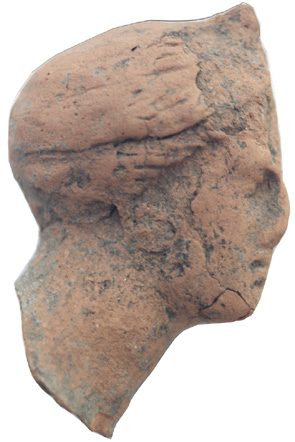
Roman-era face found in Salobreña.

history

A brief history of Salobreña

The oldest documented occupation in Salobreña dates back to the Neolithic, about 6,000 years ago. At that time, semi-nomadic shepherds left remains of their material culture in the Cave of the Captain. In those days, the Peñón de Salobreña was an island by the maritime bay later filled by the Guadalfeo River.
In the third millennium BC, a cultural change occurred in Salobreña with the appearance of copper metallurgy, megalithism, and stable settlements on rocky promontories. Archaeological finds such as pottery fragments, flint tools, and bones prove it. During the Copper and Bronze Age, the sediments of the Guadalfeo River gave rise to the first fertile plain suitable for agriculture.
The Guadalfeo River played a role in shaping the surroundings of the town. The Romans occupied Salobreña from the 2nd century BC. In fact, remains of this culture have been found throughout the area. During the High Empire in Selambina (Salobreña)  (1st-3rd centuries AD), the inhabitants in Salobreña inland cultivated vines and olives, and they developed a very specialized way of producing salted foods and sauces named garum.

From the 4th century AD to today

In the 4th century AD, Salobreña was known as Segalvina, and they mention it in the Acts of the Council of Iliberis.

During the Muslim era, in the 10th century, the inhabitants refer to Salobreña as a castle on the coast. In the 12th century, it appears as a farmhouse, and in the 14th century, the Nasrid period, it is a complete city with a central role in the coastal territory of Elvira. At that time, the most important crop was sugar cane, spread across the plain.

In the Contemporary Age, it was the scene of the War of Independence and experienced a resurgence in the sugar industry in the 19th century. In the 20th century, the tourist boom of the 60s did not seriously affect Salobreña, preserving a good part of its character. Salobreña maintains today much of its history in La Caleta, Lobres, La Vega and the old town.

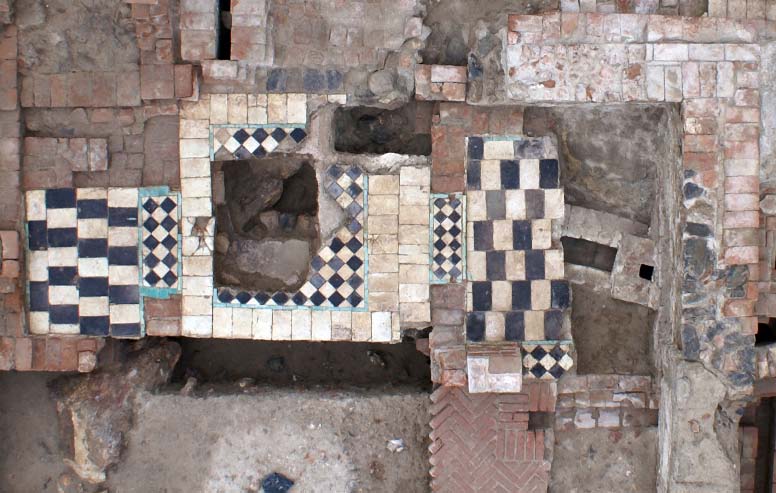
View of the entrance hall to the Nasrid bath excavated in the fortress of Salobreña.
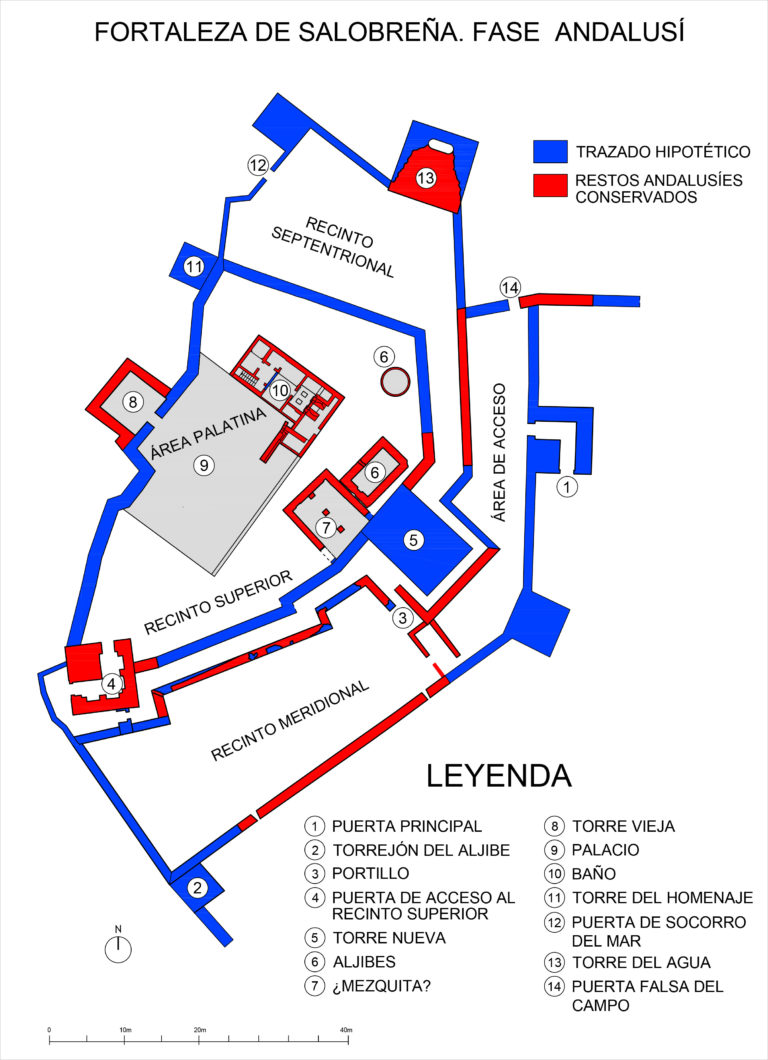
Map of the Castle of Salobreña.

Castle

The Castle of Salobreña

The Salobreña Castle, built in the 10th century, is a fortification that combines elements of Muslim and Christian architecture. Throughout history, it has had different functions, from being a prison during the Nasrid period to its abandonment and subsequent deterioration. The structure consists of several enclosures, such as the access, the northern enclosure, the southern enclosure and the upper enclosure that housed the palatine area.

During the Nasrid period, the castle was used as a royal residence and prison. Several monarchs, such as Yusuf III, Muhammad VIII the Small, Muhammad IX the Left-handed, Abu Nasr Sad and Muley Hacén, were confined in the fortress. After the conquest by the Catholic Monarchs in 1489, major reforms were carried out to adapt the castle to the new military requirements, including an artillery barrier.

In the 18th century, the castle lost its defensive effectiveness due to changes in the coastline and a period of deterioration and neglect began. During the second half of the 20th century, restoration interventions were carried out to rebuild sections of the wall and towers that had disappeared. The castle has also been used for cultural activities and has been the subject of archaeological excavations that have revealed remains of the palatine area and a Nasrid bath.

Over the centuries, it has played various roles and has experienced periods of use, abandonment and restoration. Today, it is a visited and preserved monument that shows the rich history of the area.

Tales of the Alhambra

Legend of the Three Beautiful Princesses
Washington Irving (summary)

A long time ago, when the Muslims still dominated Al-Andalus, a king named Mohammed lived in the Alhambra, known to his subjects as Al-Hayzari, “the Lefty”. They said that he was not very adept at governing because he lost the throne three times, although he recovered it three times. One day when he was riding a horse through Sierra Elvira, he saw a group of soldiers who had come from making an incursion into Christian lands. Among the many hostages they had taken was a beautiful young woman crying desperately, and her old mistress. As soon as he saw her, the monarch fell in love with her and ordered that she be delivered to him to take her to her harem.

He took her to the Alhambra and there, after convincing the nurse to speak to her wife, he managed to marry her. Both converted to Islam and changed their names, but only one is remembered, that of the nurse, who was renamed Kadiga. A few years later, the royal couple had offspring and three beautiful girls were born from the same birth: Zaida, Zoraida and Zorahaida.

As was the custom, the monarch ordered his astrologers to be consulted. They asked the king to be careful when his daughters reached marriageable age. After the birth, the queen died and the king decided to send them to the castle of Salobreña, where they were left in charge of the discreet Kadiga. 

Zaida, the eldest, was the most daring; Zoraida, the middle one, was the most beautiful; and Zorahaida, the youngest, was the most sensitive and shy.

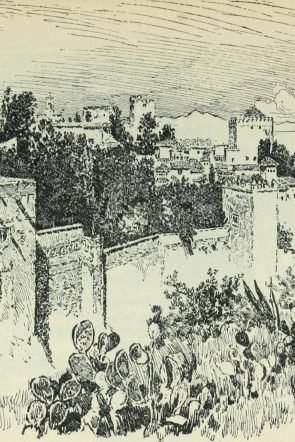
The_Alhambra_(1908)_(14777889432)
Image from the book "Tales of the Alhambra" (1908).
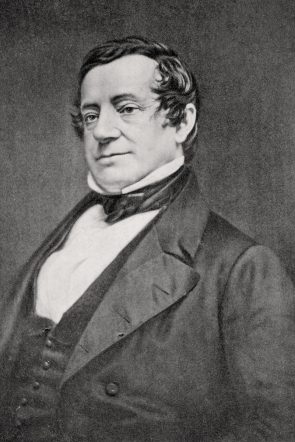
standard_washington-irving
Washington Irving, unknown author, Library of Congress USA 𝒲.
One day, while the eldest was looking at the sea through a window, a ship of soldiers arrived that brought with it three gallant Christian knights. The young princesses fell in love instantly and their mood changed completely. The monarch decided that it was time for his daughters to return to his side. Shortly before reaching Granada, the procession met some soldiers who were taking the three young Christians hostage. Everyone knelt in the presence of their lord except the young warriors, who were about to suffer death at the hands of the king… until his daughters convinced him to exchange his death for forced labor near the Alhambra. Once in the palace, the young women began to deteriorate rapidly. Kadiga, aware of what was happening to them, had an idea: she went to where the young people were working and convinced Hussein Baba, her watchman, to put them to work near the princesses’ tower. From then on their mood changed and they were happy again. But one day the gentlemen didn’t show up for work. Kadiga announced to the princesses that they had been rescued by their families and returned to their land. A few days later, the old woman appeared again in the princesses’ chambers: she had had a meeting with the young Christians in which they offered to flee her and her three lovers to the land of her parents to get married there. The young women did not hesitate for a moment and convinced Kadiga, reluctant at first, to accompany them. She also joined Hussein Baba in fleeing, as he was a Christian by birth and wanted to return to his homeland. A few nights later the three Christians went under the balcony of the princesses. They threw down a ladder to go down: Zaida and Zoraida were soon on land. It was Zorahaida’s turn, but thinking about how her father would feel when she saw that her daughters were not there she decided to go back inside the tower, cut the rope, and order her sisters to flee. It is said that the faithful Kadiga, who was riding the same horse as Hussein, fell from it while crossing a river and was found by a fisherman who took her to Spanish lands and gave her all the attention an old woman could wish for. They say that Zaida and Zoraida married Christian knights and they were very happy… and as for Zorahaida, they say that she regretted not having fled. Her father, upon discovering the escape of her sisters, locked her in a tower forever. They say that her spirit was in her for a while… but that is another story. »

La Caleta

La Caleta of Salobreña

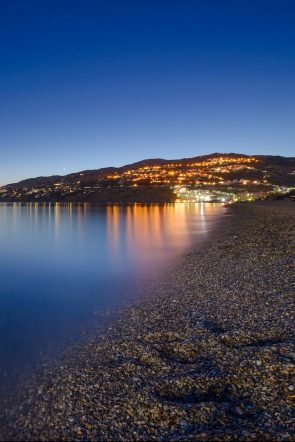
Arriving at La Caleta, near Salobreña, through the Peñón beach, one finds an enchanting environment. Its steep streets invite you to take a pleasant walk, offering tranquility and serenity, especially in its picturesque Plaza del Lavadero. Enjoying an aperitif in one of its cozy bars or watching the sunset from the sea rocks are activities worth enjoying during your stay in this place.
The annex of La Caleta is located near the old Sugar Factory, built in 1861. This factory was the only one in Europe that, for more than a century, was dedicated to processing sugar cane to obtain sugar, honey, and alcohol for to the production of rum and other products. Its busiest time was between April and July, during the so-called zafra, the sugar cane harvest season. Although it closed in 2006, the factory is an Asset of Cultural Interest in Andalusia.
La Caleta has its roots in activities related to sugar cane and fishing. Its community is friendly, simple, and affectionate. The festivities in honor of the Virgen del Carmen take place in mid-July, and one of the most outstanding events is the marine procession in which decorated boats sail slowly from La Caleta to the mouth of the river, accompanied by cheers for the Virgin and fireworks.

The Supermoon illuminates the empty pebble beach of El Peñón as the night falls on Salobreña (Spain). The lights of the small fishing town of La Caleta shine in the background. Playa del Peñón.
Salobreña, Granada, Andalucía, Spain.
Nocturnal image of La Caleta.
ERMITA-DE-SAN-ANTONIO-DE-PADUA-LOBRES.jpg
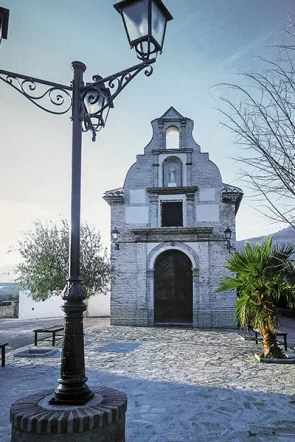
Hermitage of San Antonio de Padua, Lobres.

Lobres

Lobres, the beginning

The history of Salobreña dates back to approximately 6,000 years ago. The first traces of settlements are in Lobres, where semi-nomadic shepherds left traces of their culture in the Cueva del Capitán, near Lobres, during the Neolithic period. With the arrival of the “Argar Culture” (2000-1200 BC) and the Late and Final Bronze period (1200-600 BC), the occupation of Salobreña and its surroundings intensified. These settlements showed a complex spatial organization, controlling the territory and access routes, and had a solid agricultural and livestock economic base.
In Salobreña, you can find several deposits that correspond to newly founded settlements. Phoenicians, Romans, Arabs and Christians have left their mark on the area, taking advantage of the agricultural lands of Lobres and contributing to the configuration of its population center. The people of Salobreña are diligent and keen on garden agriculture and tropical crops. We recommend walking through its rural roads and discovering the quiet and bright streets and alleys in town.
Popular festivities are well-known in the region. The Candelaria festivities are in February, and the San Antonio festivities, the patron saint of Lobres, which take place in the month of June, stand out.